· 7 min read
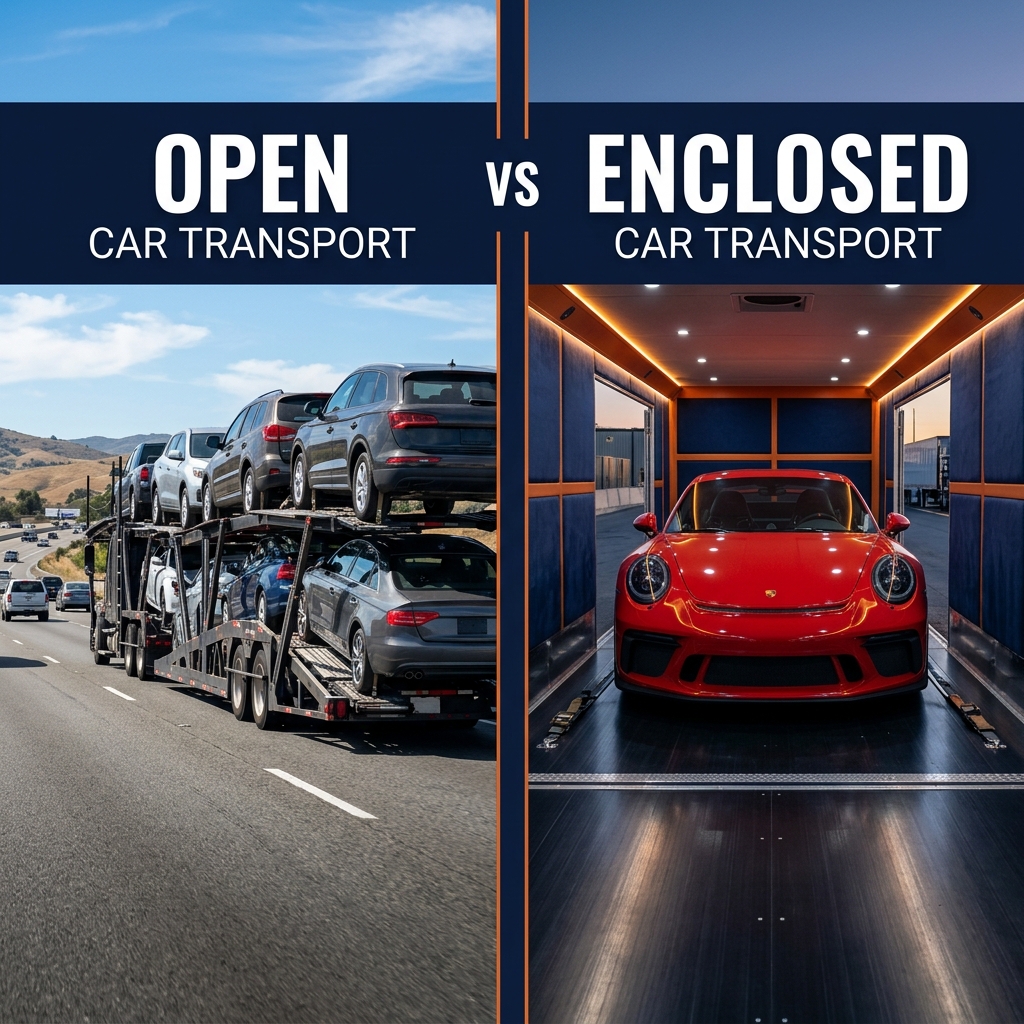
Two Methods, One Decision
Every vehicle shipped in the United States travels on one of two equipment types: an open carrier or an enclosed trailer. The choice affects your price, your pickup window and, in rare circumstances, your insurance outcome. This guide gives you the honest, practical difference — not the marketing version — so you can decide correctly the first time.
If you already know which type you want, use our instant quote tool to see real carrier-backed pricing for your specific lane.
Open Transport: What It Actually Means
Open car transport uses a multi-level, uncovered carrier — the type you see loaded with new vehicles on every major highway. Open carriers hold eight to ten vehicles at once. Your car is exposed to weather, road dust and the occasional highway debris. That sounds alarming; statistically, it is not.
Manufacturers, dealerships and rental companies ship new and used inventory open every day, including brand-new luxury sedans and high-end SUVs. Roughly 90% of all privately shipped vehicles in the US travel open. Carrier availability is high, pickup windows are short (typically 1–3 business days on dense lanes) and the cost per mile is the lowest available.
Open transport is the right choice for the vast majority of vehicle owners. If your car runs on public roads, parks in public lots and faces rain without special treatment, it is an open-transport vehicle.
Enclosed Transport: What It Actually Means
Enclosed car transport places your vehicle inside a hard-sided trailer — fully roofed, walled and sealed. The interior shields the vehicle from weather, road debris and visual exposure. Most enclosed carriers use soft-strap tie-downs that contact the tires rather than the frame or undercarriage, which is important for low-clearance exotic cars. Many carry hydraulic liftgates for vehicles that cannot roll over a standard ramp.
Fewer enclosed carriers operate in the market than open, which has two practical consequences: pickup windows are longer (3–7 days on most lanes, sometimes more in rural areas) and prices are higher. Enclosed is not "safer" for the average vehicle in any meaningful way — it is more appropriate for vehicles where any weather exposure or road contact represents an unacceptable risk.
The Real Cost Difference
Enclosed transport typically costs 35–50% more than open transport on the same lane, on the same date. That is a firm rule of thumb derived from real lane data across thousands of shipments.
- Open quote: $800 → Enclosed: $1,080–$1,200
- Open quote: $1,200 → Enclosed: $1,620–$1,800
- Open quote: $1,600 → Enclosed: $2,160–$2,400
- Open quote: $2,000 → Enclosed: $2,700–$3,000
The dollar gap widens on longer routes. A cross-country open-transport move at $1,400 saves you $490–$700 over the enclosed alternative. For a daily-driver sedan, that premium buys nothing of practical value. For a $250,000 Lamborghini, it buys peace of mind and appropriate equipment. To understand the full cost breakdown, see our guide on how much it costs to ship a car.
Insurance Limits: The Most Important Practical Difference
Federal law (49 CFR Part 387) requires all motor carriers to maintain a minimum of $750,000 in combined liability coverage. Most open carriers meet exactly this minimum. Most enclosed carriers hold $1,000,000 or higher, and specialty single-car enclosed operators routinely carry $500,000 per vehicle in cargo-specific coverage.
Here is the critical scenario: if your vehicle is worth $400,000 and the carrier's cargo limit is $750,000, you have theoretical coverage — but cargo claims are rarely paid at full retail value. Ask the broker explicitly: "What is the carrier's cargo-specific coverage limit per vehicle, and do you carry a contingent policy?" Our carriers hold limits up to $500,000 per vehicle, and we maintain a contingent policy behind every carrier's primary coverage.
The Vehicle-Value Threshold
At what value should you switch from open to enclosed? The most useful rule of thumb: when the cost of a carrier-caused cosmetic claim would exceed the enclosed premium, choose enclosed.
For most vehicles, that threshold lands around $70,000–$80,000 in current market value. Below that, the statistical probability of a claim times the typical claim value does not justify the enclosed premium. Above that, the math changes — and so does the carrier equipment you need for low-clearance vehicles.
Always choose enclosed for:
- Exotic and supercar transport where any exterior contact is unacceptable
- Classic and antique vehicles being transported to or from shows, concours events or auctions
- Vehicles with ground clearance under 4 inches that cannot use a standard ramp
- High-value collector vehicles where condition directly affects resale price
Carrier Availability: A Practical Reality
Open carriers are common. On a dense lane like Los Angeles to Dallas or Chicago to Atlanta, dozens of open carriers move vehicles weekly. A 1–3 day pickup window is realistic.
Enclosed carriers are scarce relative to demand. On popular lanes in peak season, enclosed carrier slots book out days or weeks in advance. On rural or low-density routes, an enclosed carrier may take 5–10 days to assign. If your schedule is tight, enclosed transport requires earlier booking. During snowbird season in Florida and Arizona, enclosed availability on those lanes tightens significantly — book 6–8 weeks out.
Who Should Always Choose Open Transport
- Owners of daily drivers, commuters and leased vehicles
- Vehicles valued under $70,000
- Dealer moves and fleet relocations
- Online car buyers shipping a recently purchased used vehicle
- Military PCS moves and college relocations
- Anyone on a budget where the enclosed premium is not justified
See our open car transport service page for current pricing and availability.
Who Should Always Choose Enclosed Transport
- Owners of exotic cars, supercars and hypercars
- Classic car collectors and restoration owners
- Show vehicles where cosmetic perfection is required
- Vehicles transported to or from auction where condition affects sale price
- Vehicles with ground clearance under 4 inches
- Any owner whose peace of mind is worth the premium
See our enclosed car transport service page for white-glove options.
The Honest Verdict
Open transport is not a compromise — it is the appropriate choice for the overwhelming majority of vehicles. Enclosed transport is not a luxury upgrade — it is a specialized service for specific vehicles and specific owners. The decision is not about which is "better" in the abstract; it is about which is right for your vehicle's value, condition requirements and timeline.
If you are still unsure, call us. Our coordinators will give you an honest recommendation based on your specific vehicle — not an upsell.

ACS Dispatch & Compliance Team
Written by the American Car Shipping operations team. With over a decade of experience and 41,000+ vehicles successfully transported, we share practical industry insights, pricing transparency, and carrier vetting strategies.